VAT & records
VAT on taxi fares for UK PHV operators: TOMS closed
At a glance
Supreme Court refused Bolt's TOMS appeal on 29 Sep 2026. Full-fare VAT for principals, agency rules, parked claims and a clear job-level VAT checklist.
Use the section links to find the rules, office actions and sources.
At a glance
| Question | Short answer |
|---|---|
| Is TOMS still available for ordinary taxi/PH journeys? | No for supplies on or after 2 January 2026, unless the journey is ancillary to accommodation or qualifying passenger transport in the same package. |
| Did Bolt win at the Supreme Court? | No. Permission to appeal was refused on 29 September 2026 (UKSC/2026/0096). |
| What does a principal pay VAT on? | The full fare (plus taxable extras), not only the margin after paying the driver. |
| What about a disclosed agent? | Your taxable supply is usually the commission or booking fee. Do not issue a VAT invoice on fares for unregistered drivers. |
| Has HMRC updated Brief 8 after the refusal? | Not as of 16 October 2026. The November 2025 brief still says HMRC would review parked TOMS claims once litigation finally concluded. |
| Is this tax advice? | No. Confirm your contracts and returns with a qualified adviser and the live GOV.UK pages. |
Why this matters now
Three things changed the picture for every VAT-registered office that buys in and resells journeys.
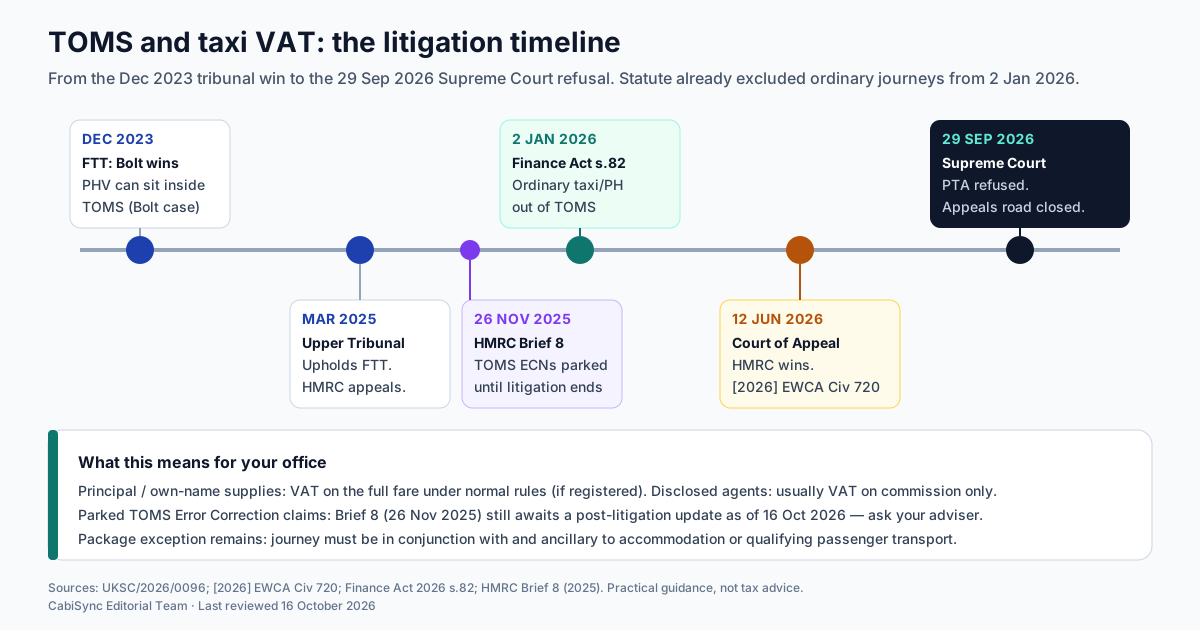
- The appeals road closed. The Supreme Court refused Bolt Services UK Ltd permission to appeal on 29 September 2026. The Court of Appeal judgment in HMRC v Bolt Services UK Ltd [2026] EWCA Civ 720 (12 June 2026) stands: on-demand private hire supplies of that kind were not services "of a kind commonly provided by tour operators or travel agents".
- Statute already locked the future. Finance Act 2026 section 82 amends section 53 of the Value Added Tax Act 1994. For supplies made on or after 2 January 2026, a person is not a tour operator so far as their business consists of transporting passengers by private hire vehicle or taxi, unless those supplies are made in conjunction with, and are ancillary to, accommodation or passenger transport by bus, coach, train, ship or aircraft.
- Parked claims still sit on Brief 8's old wording. Brief 8 (published 26 November 2025) said HMRC would reject PHVO TOMS Error Correction Notifications while litigation continued, and would review the position once it finally concluded. Litigation has now concluded in HMRC's favour. As of 16 October 2026, no replacement brief or GOV.UK update on those parked claims was published.
Trade press (TaxiPoint, September 2026) reported that the Treasury is not offering a fresh consultation on taxi VAT. We have not found an official Treasury statement, so treat this as reporting rather than policy.
The problem in your office
Most independent operators do not live inside TOMS. The live risk is quieter and more local.
- Wrong bucket per job type. Cash work, NHS or council account work, app work, subcontracted overflow and hotel-package transfers can sit in different VAT buckets on the same day.
- Agent label, principal practice. Calling yourself "agent" does not decide it. HMRC and the courts look at contracts and working practices. London licensing law generally requires operators to contract as principal with the passenger (R (United Trade Action Group Ltd) v Transport for London [2021] EWHC 3290 (Admin)). Outside London, DELTA Merseyside Ltd v Uber Britannia Ltd [2024] EWCA Civ 802 distinguishes the 1976 Act regime.
- Driver threshold maths vs operator income. VAT Notice 700/25 (section 2.2) tells a self-employed driver to test the VAT registration threshold on the full amount paid for their journeys, adding back vehicle and radio rentals or agency charges the firm deducts. For you as the operator, the radio rent and commission you charge drivers are your own taxable income (sections 1.2 and 3.7), not an add-back.
- Stale adviser notes. Industry pages still quote the Upper Tribunal Bolt win or say operators "may be using TOMS". That is no longer the live picture for on-demand PHV as principal.
The rules and primary sources
This section is practical operator guidance, not tax advice. Always check the live GOV.UK and legislation.gov.uk pages on the day you change a process.
1. Normal VAT rules for taxis and private hire
VAT Notice 700/25 still sets the day-to-day framework:- Fares for taxi or private hire journeys are standard-rated. So are extras such as baggage and waiting time.
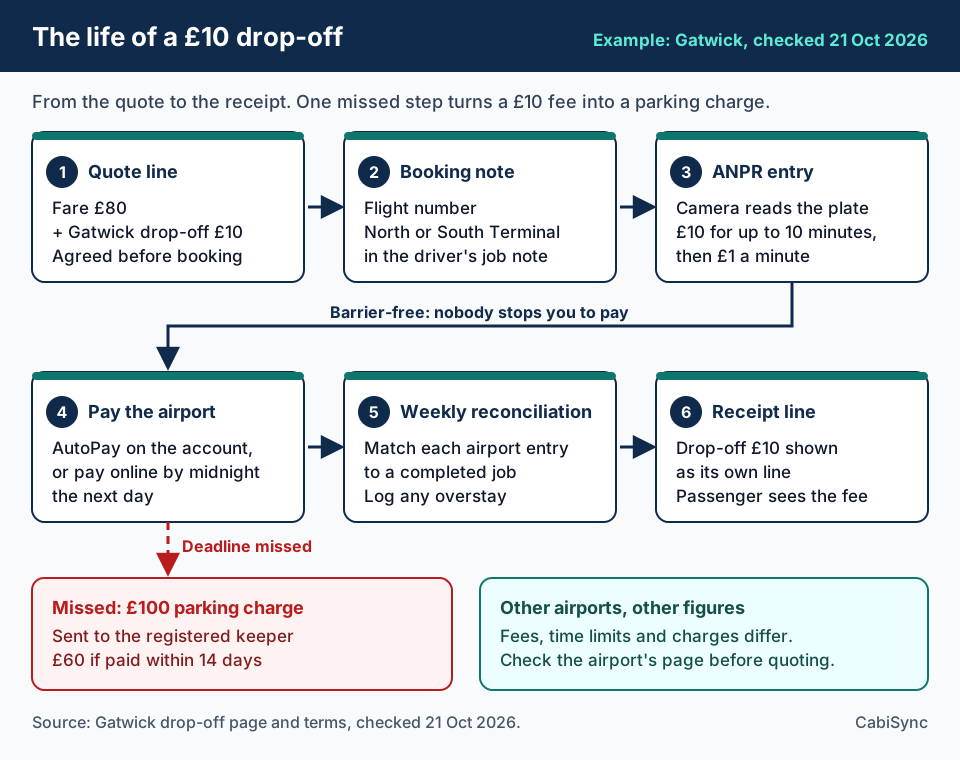
- Passing on a third-party cost, such as an airport drop-off charge, raises a separate question: is it a disbursement under VAT Notice 700 section 25.1, or part of your taxable fare? Our airport drop off charges guide sets out the tests to take to your adviser.
- Voluntary tips are outside the scope of VAT.
- If you act as principal, you account for VAT on the full amount payable by the customer, including fares taken by you as a driver, subcontracted work and referral fees.
- If you act as a disclosed agent, the driver usually supplies the transport. Your taxable supply is the agency fee (and other charges such as radio rental). You must not charge VAT or issue a VAT invoice on fares for drivers who are not VAT-registered.
- Cash work and account work can sit in different roles only if your contracts and practices genuinely differ.
2. The TOMS exclusion from 2 January 2026
Finance Act 2026 section 82 inserts new subsection (3A) into section 53 VATA 1994. In plain terms:- Ordinary private hire or taxi passenger transport is carved out of the "tour operator" definition for TOMS.
- The carve-out does not apply where the journey is supplied in conjunction with, and ancillary to, accommodation or passenger transport by bus, coach, train, ship or aircraft.
- The change has effect for supplies made on or after 2 January 2026.
The Budget 2025 tax information and impact note confirms the operative date and the ring-fence of historic litigation to past periods.
3. The Bolt litigation timeline (now final)
| Date | What happened |
|---|---|
| Dec 2023 | First-tier Tribunal allowed Bolt's appeal ([2023] UKFTT 01043 (TC)): on-demand PHV could fall within TOMS. |
| Mar 2025 | Upper Tribunal upheld that outcome ([2025] UKUT 00100 (TCC)). |
| 2 Jan 2026 | Statutory exclusion for supplies of taxi/PH journeys from TOMS (Finance Act 2026 s.82), with limited package exceptions. |
| 12 Jun 2026 | Court of Appeal allowed HMRC's appeal: [2026] EWCA Civ 720. On-demand mini-cab services of that kind were outside TOMS. |
| 29 Sep 2026 | Supreme Court refused Bolt permission to appeal (UKSC/2026/0096). |
| 16 Oct 2026 | Brief 8 still shows its 26 Nov 2025 text. No new HMRC brief on parked ECNs found. |
Sources: Supreme Court case page; Judiciary CoA page.
The Court of Appeal recorded that Bolt's appeal involved an estimated £190m, and that other cases with sums well in excess of £1bn were awaiting its outcome ([2026] EWCA Civ 720, para 11).
4. London vs outside London (licensing is not a VAT statute)
London and the rest of England sit under different licensing statutes. In R (United Trade Action Group Ltd) v Transport for London [2021] EWHC 3290 (Admin), the Divisional Court held that a London PHV operator who accepts a booking must contract as principal with the passenger. DELTA Merseyside Ltd v Uber Britannia Ltd [2024] EWCA Civ 802 (and the later Supreme Court appeal on the 1976 Act) distinguishes the outside-London regime: agency and intermediary models can still be lawful where the contracts and practices support them. Brief 8 records that licensing background. ProDriver (8 Oct 2026) reports that agency-model operators outside London can still account for VAT on commission only where the structure is genuine, and that HMRC confirmed the TOMS removal does not by itself rewrite disclosed-agency supplies.
That does not mean every office outside London is safe with an "agency" stamp. Notice 700/25 still turns on substance. Map each job type.
5. Registration threshold: drivers and operators
A business must register for VAT if its VAT taxable turnover is more than £90,000 in a rolling 12 months, or if it expects to go over that in the next 30 days (GOV.UK VAT registration thresholds).
- Self-employed drivers: Notice 700/25 section 2.2 says a driver tests the threshold on the full amount paid for their supplies, adding back any vehicle and radio rentals or agency charges the taxi firm deducts before paying them.
- Operators: the radio rent, vehicle rental and commission you charge drivers are your own taxable supplies (Notice 700/25 sections 1.2 and 3.7). They count towards your turnover as income in their own right, not as an add-back. If you act as principal, the full fares also count.
Check the live GOV.UK threshold page before you act; the figure can change.
Which VAT bucket is this job in?
Use this table as an office prompt. It does not replace advice on your contracts.
| Job type | Typical VAT base if you are VAT-registered | Did ordinary TOMS ever apply after the CoA / statute? | Records that prove the bucket |
|---|---|---|---|
| London app / own-name private hire | Full fare (principal model required by London licensing practice) | No for on-demand PHV of the Bolt kind; statute excludes ordinary journeys from 2 Jan 2026 | Passenger Ts&Cs, driver Ts&Cs, booking confirmation naming your firm, fare and VAT invoice trail |
| Outside-London disclosed-agent cash job | Commission / booking fee (driver supplies the transport if genuinely disclosed) | TOMS was never the right tool for disclosed agency | Driver agreement, passenger disclosure of the driver as supplier, commission ledger, no VAT invoice on unregistered-driver fares |
| NHS / council / corporate account job | Often full fare if you contract as principal with the account | Same as other principal supplies; package exceptions rare | Account contract, purchase order, invoice in your name, settlement to driver |
| Subcontracted overflow job | Full fare if you remain principal to the customer (Notice 700/25) | Same | Customer booking, subcontract invoice, your sales invoice, driver/subcontractor settlement |
| Hotel-package or tour transfer bought in with accommodation / principal travel | May still sit in TOMS if the journey is in conjunction with and ancillary to accommodation or qualifying passenger transport | Yes — this is the statutory exception | Package booking showing room/flight/coach plus transfer sold together, TOMS annual adjustment workings |
If you used TOMS before 2 January 2026, or lodged a TOMS ECN
Brief 8 told operators four things that still matter:
- HMRC's policy view was always that private hire supplies did not fall within TOMS and VAT was due on the full fare.
- Operators who had already filed on normal accounting did not have to rework past periods solely because of the earlier tribunal wins.
- Operators who believed they met TOMS conditions after the Bolt tribunal outcomes could submit an Error Correction Notification (subject to the four-year time limit), emailing
ccg.phvotomsclaims@hmrc.gov.ukwith subject linePHVO TOMS Claim RCB 08/25. HMRC said it would reject such claims while litigation continued, that an appeal was needed to protect a claim, and that it would review the position once the Bolt litigation finally concluded. - Businesses that had already used TOMS were warned: "in HMRC's view VAT was due on the basis of the full fare, not on the basis of their margin after paying the driver. We may therefore take action to protect the revenue pending final determination of the litigation."
- The litigation route for Bolt is closed. The Court of Appeal outcome stands.
- The forward-looking statute already stopped ordinary taxi/PH TOMS use from 2 January 2026.
- What has not changed in published HMRC guidance: Brief 8 still carries its 26 November 2025 text. No later Revenue and Customs Brief on parked PHVO TOMS claims was found on GOV.UK as of this review.
- Do we have any open PHVO TOMS ECN or related appeal on file?
- Which VAT periods does it cover, and are any still inside the four-year window?
- Does Brief 8 or any later HMRC brief (check the live page the day you meet) say how parked claims will now be closed?
- For periods before 2 January 2026, what is HMRC's expected treatment given [2026] EWCA Civ 720?
- For periods on or after 2 January 2026, are we fully on normal VAT accounting for non-excepted journeys?
- Have we separated disclosed-agent jobs from principal jobs in the records HMRC would ask for?
Do not assume a refund is coming. Do not ignore an open appeal. Get written advice before you withdraw, amend or chase a claim.
Step by step: what to do this month
Step 1: Map every live job type
List cash, card, app, NHS/council account, corporate account, subcontracted and package-transfer work. Mark each as principal, disclosed agent, or "needs advice".
Step 2: Read the live primary sources
Open Brief 8, Notice 700/25, Finance Act 2026 section 82 and the Supreme Court case page. Save PDFs or printouts with today's date in your compliance folder.
Step 3: Fix the registration maths
Rebuild your own taxable turnover: radio rent, vehicle rental and commission charged to drivers, plus full fares on any work you supply as principal. Compare it to the £90,000 threshold. Give drivers statements showing gross fares before your deductions, because that is the figure their own threshold test uses.
Step 4: Rebuild weekly driver statements
Each statement should show total fares (cash and account), deductions, net, and enough detail to reconcile to the booking system. That pack supports VAT returns, tax returns and account-customer invoices.
Illustrative example: David Khan drives for Thornbeck Vale Cars. His week shows £1,450 total fares (£620 cash, £830 account). Thornbeck Vale deducts radio rent and commission. For David's own VAT threshold test, the £1,450 counts before those deductions. For Thornbeck Vale, the radio rent and commission are its own taxable income, and if it supplies the account work as principal, the £830 account fares are its supplies too.Step 5: Stop issuing the wrong VAT invoice
If you are a disclosed agent and the driver is not VAT-registered, do not put VAT on the passenger fare or issue a VAT invoice for that fare. If you are principal and registered, invoice the full fare correctly.
Step 6: Brief the accountant on parked TOMS points
Send them the timeline table and ask the six questions in the section above. Diary a follow-up when HMRC publishes any new brief.
Step 7: Align related tax jobs
Making Tax Digital, capital allowances on vehicles and equipment, and tax check codes at licence renewal sit next to VAT in the same office calendar. Link them so the same records feed each process.
Checklist: VAT-ready office pack
- Job-type map (principal vs disclosed agent) signed off by the office manager
- Live copies of Brief 8, Notice 700/25 and Finance Act 2026 s.82 dated in the folder
- Contracts and passenger wording match the bucket you claim
- Weekly driver statements reconcile to bookings (cash and account split)
- Operator turnover includes radio rent and commission (and principal fares); driver statements show gross fares for drivers' own threshold checks
- No VAT invoices on unregistered-driver fares where you are only agent
- Principal account invoices show net, VAT and gross correctly
- TOMS ECN / appeal status logged (or confirmed none)
- Package-transfer exceptions documented only where the journey is truly ancillary
- Adviser review booked if any bucket is unclear
Common mistakes
- Treating the Upper Tribunal Bolt win as current law. The Court of Appeal reversed it; the Supreme Court refused a further appeal.
- Using TOMS for ordinary journeys after 1 January 2026. Statute excludes those supplies from 2 January 2026, save the package exception.
- "We're agent" with invoices in the firm's name. Labels do not beat contracts and practice.
- Leaving radio rent and commission out of your turnover. They are your taxable income as operator and can take you over £90,000. (Add-backs are the driver's test, not yours.)
- One VAT rule for cash and account with no genuine split. Notice 700/25 allows a split only where terms and practices differ.
- Assuming HMRC has already written to every parked claimant. Brief 8's review promise has not yet been replaced by a public update.
- Issuing a voluntary VAT invoice when unregistered. You can become liable for the VAT shown (VATA 1994 Schedule 11 paragraph 5(2)).
- Mixing hotel-package transfers with ordinary local work in one TOMS pot. The exception is narrow.
- Waiting for a new Treasury consultation. Trade press in September 2026 reported none was planned; plan on the current rules.
Related operations
- Digital VAT records and Making Tax Digital: Making Tax Digital for taxi and private hire operators
- Vehicle and equipment tax relief: Capital allowances for taxi and private hire operators
- Licence renewals and HMRC tax check codes: Tax check codes for taxi and private hire
- Driver engagement checks that sit beside accounts: Right to work checks for private hire operators
FAQs
Do taxis charge VAT?
Taxi and private hire fares are standard-rated when supplied by a VAT-registered business that is the supplier of the transport. Many individual drivers sit below the registration threshold, so passengers often see no VAT line. Tips given voluntarily are outside the scope of VAT.
What did the Supreme Court decide about Bolt and TOMS?
It refused permission to appeal on 29 September 2026. It did not hear a full appeal. The Court of Appeal decision that Bolt's on-demand PHV services were outside TOMS remains in force.
From which date are ordinary taxi and PH journeys excluded from TOMS?
Supplies made on or after 2 January 2026, under Finance Act 2026 section 82, except where the journey is supplied in conjunction with and ancillary to accommodation or qualifying passenger transport.
Can an outside-London office still use an agency model?
Licensing and VAT practice still allow disclosed agency outside London where the contracts and working practices support it. Your taxable supply is then usually the commission. Confirm with an adviser; do not rely on the word "agent" alone.
What about London operators?
London PHV licensing practice generally requires the operator to contract as principal with the passenger. VAT-registered principals account for VAT on the full fare under normal rules.
Has HMRC told operators what happens to parked TOMS ECNs?
Brief 8 said claims would be rejected while litigation continued and reviewed when it finally concluded. As of 16 October 2026, no later public brief updating that process was found. Ask your adviser to check the live Brief 8 page and any new RCB before you act.
What records does HMRC expect?
Journey-level fare records, driver settlements that reconcile, a cash vs account split, and (if registered) sales and purchase invoices that support the VAT return. GOV.UK says you must keep VAT records for at least 6 years (10 for the One Stop Shop schemes).
Is CabiSync giving tax advice?
No. CabiSync builds software for UK private hire operators. Confirm VAT treatment with a qualified accountant or tax adviser and with HMRC's published guidance.
What to do next
- Print the job-type VAT bucket table and mark every live workstream.
- Save Brief 8, Notice 700/25, Finance Act 2026 s.82 and the Supreme Court case page into your compliance pack with today's date.
- Rebuild one month of driver statements and match them to bookings.
- Ask your adviser the parked-claims questions if you ever used TOMS or filed an ECN.
- Diary a re-check of the Brief 8 GOV.UK page for any post-litigation update.
- Connect VAT records to your MTD and capital-allowances folders so month-end is one trail, not three.
Want a second pair of eyes?
Book a free 15-minute compliance review with CabiSync. We look at how your job types, driver statements and account invoices sit together so your accountant gets a clean pack. Your radio room stays yours.
CabiSync plans start at Starter £29/week and Professional £42/week. We make taxi dispatch software for UK private hire operators. We are not HMRC and not a tax adviser.
Sources
- UK Supreme Court: Bolt Services UK Ltd v HMRC, UKSC/2026/0096 (PTA refused 29 September 2026; page updated 2 October 2026)
- Courts and Tribunals Judiciary: HMRC v Bolt Services UK Ltd [2026] EWCA Civ 720 (12 June 2026)
- legislation.gov.uk: Finance Act 2026 section 82 (supplies on or after 2 January 2026)
- HMRC: Revenue and Customs Brief 8 (2025) — VAT TOMS supplies by PHV or taxi operators (published 26 November 2025; still current text as of 16 October 2026)
- HMRC: How VAT applies to taxis and private hire cars (VAT Notice 700/25)
- HMRC: Private Hire Vehicle Operators and the change in legislation for the Tour Operators' Margin Scheme (TIIN, published 26 November 2025)
- TaxiPoint: End of appeals road: Bolt refused Supreme Court appeal in £190m VAT dispute
- MHA: Supreme Court's refusal to hear Bolt's appeal (Sue Rathmell, 8 October 2026; cites £190 million for Bolt)
- DM News: Supreme Court refuses Bolt permission to appeal in HMRC VAT case (8 October 2026)
- ProDriver: Bolt refused Supreme Court appeal in HMRC VAT dispute (8 October 2026)
- TaxiPoint: Treasury offers no fresh taxi VAT consultation (9 September 2026)
- The National Archives: Bolt Services UK Ltd v HMRC [2023] UKFTT 01043 (TC)
- The National Archives: DELTA Merseyside Ltd v Uber Britannia Ltd [2024] EWCA Civ 802
- The National Archives: R (United Trade Action Group Ltd) v Transport for London [2021] EWHC 3290 (Admin)
- legislation.gov.uk: VATA 1994 Schedule 11 paragraph 5
- GOV.UK: VAT registration thresholds; VAT record keeping
Practical operator guidance based on public legislation, HMRC material and trade reporting. Not tax or legal advice. Re-check live GOV.UK pages before you change returns or claims.
Last reviewed: 16 October 2026 Byline: CabiSync Editorial Team Originally published: 31 August 2026