Starting a taxi company
How to start a taxi business in the UK: a practical guide
At a glance
How to start a taxi business in the UK: plan licences, recruit drivers, price journeys and manage bookings. Use practical worksheets to prepare your launch.
Use the contents below to find the part you need.

Here is how to start a taxi business in the UK: choose your service, confirm the appropriate operator, driver and vehicle licences, arrange insurance, recruit suitable drivers and set up bookings. Build a budget from actual quotes before committing to vehicles or premises.
The challenge is making those parts fit together. You might have plenty of enquiries but no drivers available at the right time. You might win an airport booking that looks profitable until you include parking, waiting and the empty return journey.
This guide explains how to start a taxi company with those everyday decisions in mind. It covers licensing, startup costs, recruiting private hire drivers, pricing journeys and organising bookings.
The calculations below are illustrative worksheets, not market prices or customer results. Replace their assumptions with your own quotes and payment arrangements.
1. Choose a service you can deliver reliably
Start with a specific customer need and an area you can cover consistently.
Possible services include local private hire, airport transfers, corporate travel, executive journeys, accessible transport and school contracts. Each needs a different combination of vehicles, driver availability and office support.
Test a service before advertising it
For an airport-transfer service, ask local hotels about early departures. Check journey times at the hours you plan to work. Confirm driver availability and the cost of returning empty.
Keep a demand sheet with the requested route, time, vehicle needs and whether the enquiry becomes a booking. A list of enquiries can look impressive; the fuel supplier tends to prefer paid journeys.
- Which requests repeat?
- Can your available drivers cover them?
- Will the fare cover waiting and repositioning?
- What is the lawful backup arrangement if a vehicle breaks down?
Write down your operating limits
Define your service area, hours, vehicle capacity and booking notice. A booking confirmation should state whether an enquiry has been accepted, the agreed pickup details and any limits on availability.
Your advertised availability should reflect the service you can actually staff.
2. Confirm licensing before committing to premises or vehicles
“Taxi company” is commonly used for both taxis and private hire businesses, but the licensing rules differ.
In England and Wales, licensed taxis can generally accept street hails and use authorised ranks within their licensing rules. Private hire vehicles must be booked in advance through a licensed operator. Drivers need the appropriate licence. See the government’s driver licensing guidance.
For a private hire business in England and Wales, consider three separate permissions:
| Permission | What it covers |
|---|---|
| Operator licence | The business accepting private hire bookings |
| Driver licence | The person driving passengers |
| Vehicle licence | The vehicle used for licensed journeys |
Arrangements differ across the UK. Check with the relevant council, Transport for London or Northern Ireland licensing service before proceeding. London has a dedicated private hire operator application process, and Northern Ireland has a separate taxi operator licensing process. Scottish councils administer taxi and private hire licensing; ask about booking office licensing too.
Practical task: send the licensing team a clear description
Instead of asking only, “How do I get a licence?”, describe your proposed operation:
“I plan to accept pre-booked private hire journeys from an office at this address, initially using owner-drivers. Please confirm the operator application requirements, premises conditions, driver and vehicle licensing arrangements, record-keeping requirements and current fees.”
A specific enquiry helps identify problems before you sign a lease or buy a vehicle.
3. Build a taxi business plan around available capacity
A useful taxi business plan explains how you will fulfil work as well as attract it. Include your service area, expected bookings, driver arrangements, costs, pricing, marketing and cash requirements. Then test your assumptions against a sample working week.
Build a coverage sheet, not just a driver list
A driver registered with your company may be unavailable during the hours you need. Record agreed availability by shift, vehicle type and existing commitments.
| Coverage field | What to record |
|---|---|
| Working window | Confirmed start and finish, plus breaks |
| Vehicle suitability | Passenger space, luggage and accessibility requirements |
| Existing commitments | Recurring jobs, airport work and repositioning time |
| Backup cover | Who the office contacts if the allocation fails |
Compare availability against requested pickup times before promising coverage.
Check bookings door to door
An airport drop-off may occupy a driver well beyond the passenger’s arrival time. Include travel to the passenger, loading, the journey, unloading and repositioning.
Treat each booking as a block of working time. This helps prevent allocating a second job because the first fare has ended, even though the driver cannot reach the next pickup.
Register the business and organise its finances
Choose a suitable structure, such as a sole trader, partnership or limited company. Follow the government’s business setup guidance. Keep journey income, driver payments, expenses and invoices organised from the start. Check the tax requirements for your licence application and renewal with the authority and HMRC.
4. Calculate startup costs and working capital separately
There is no single cost to start a taxi business in the UK. Your funding needs depend on your licensing authority, vehicles, insurance, driver model and premises.
Get actual quotes for licensing and assessments; vehicle purchase, rental or finance; appropriate insurance; premises and communications; dispatch software and payment processing; recruitment and marketing; maintenance, cleaning and repairs.
Then calculate how much cash you need to keep operating while customers and payments build up.
Cash-flow worksheet: when do you actually get paid?
Use these hypothetical inputs: £4,000 in monthly journeys and £3,000 in associated driver payments. The subtraction leaves £1,000 before other costs; it does not establish net profit.
Now assume invoices are issued at month-end, payment is due 30 days later and drivers are paid weekly. Put those payment dates on a calendar. You need cash to pay drivers while the customer’s invoice remains outstanding.
Before accepting account work, decide when you will invoice, when payment is due, how much unpaid work you can fund and when an overdue account will be reviewed or suspended.
Your cash forecast should follow payment dates, rather than only completed journeys. Use the taxi business break-even calculator to explore how costs and booking levels affect your plan.
5. Recruit drivers for the work you need covered
Driver recruitment deserves as much attention as customer acquisition. Decide whether you need owner-drivers, drivers for company vehicles or a mixture. Identify the hours and vehicle types you need most.
Example: make your recruitment advert specific
A vague advert might say: “Drivers wanted. Plenty of work. Call now.”
A more useful advert would explain:
“Private hire owner-drivers wanted for weekday morning and afternoon cover in our service area. Local bookings, airport transfers and account work. Contact us for current charges, payment schedules, document requirements and onboarding details.”
Only describe work and earnings you can substantiate. Drivers need enough information to judge whether joining makes sense.
Explain the working arrangement before onboarding
Give applicants clear information about commission, rent and other charges; payment dates; job allocation; cash and card handling; waiting time and cancellations; expected availability; customer service standards; and how disputes are handled.
Use agreements that reflect the actual relationship and obtain appropriate advice on employment status and responsibilities.
Create a repeatable onboarding process
For each driver, verify the licences, vehicle documents, insurance and other permissions relevant to the work. Confirm that the licensing arrangements are appropriate for your operation.
Then walk through a sample job:
- Receive and acknowledge the allocation.
- Check the pickup details.
- Report arrival and any delay.
- Follow the agreed waiting or no-show procedure.
- Record completion and payment correctly.
Track document expiry dates and establish who stops allocations when required documents expire or cannot be verified.
Retain drivers through dependable administration
Before recruiting more drivers, ask whether existing drivers receive clear statements, timely payments and useful support. A driver should be able to question a fare or deduction and receive an explanation based on the booking record.
See how CabiSync driver management fits into your office workflow.
6. Choose vehicles against real journeys
Confirm licensing eligibility before buying or leasing. Local requirements can affect vehicle age, emissions, inspections, seating and equipment. Check the government’s vehicle licensing guidance.
Check passenger space and luggage separately
Record the passenger count, luggage dimensions, pushchairs, mobility equipment and restraint requirements. Check the actual vehicle can take the whole load. A seating-capacity figure cannot tell you whether a pushchair fits in the boot.
For family bookings, include your seat belt and child-restraint briefing in the preparation process.
Also calculate running costs, servicing access and downtime. If owner-drivers supply vehicles, apply consistent suitability and condition checks.
7. Price the full job, including empty mileage
For licensed taxis, check applicable tariff rules. For private hire work, establish a consistent quoting method and explain additional charges before confirmation. Consider pickup mileage, driving time, waiting, parking, driver payments and repositioning.
Fare worksheet: £75 received is not £75 earned
Use the following illustrative assumptions, not a suggested airport price:
| Illustrative item | Amount |
|---|---|
| Customer fare | £75 |
| Driver payment under the agreed arrangement | £50 |
| Parking paid by the operator | £6 |
| Payment processing cost | £1 |
| Contribution before remaining overheads | £18 |
In this example, the driver payment is assumed to cover the vehicle and fuel. With a company vehicle, those costs would need separate treatment. Tax treatment is not modelled in this simplified calculation.
Do not set fares by copying another firm’s price. Under these assumptions, £75 leaves £18 before the remaining overheads and tax. Your costs determine whether the job works. Recalculate for waiting, empty mileage and your own driver arrangements.
Write policies for waiting time, parking, extra stops, cancellations and no-shows before staff begin quoting. Test the quote using your actual costs before accepting it.
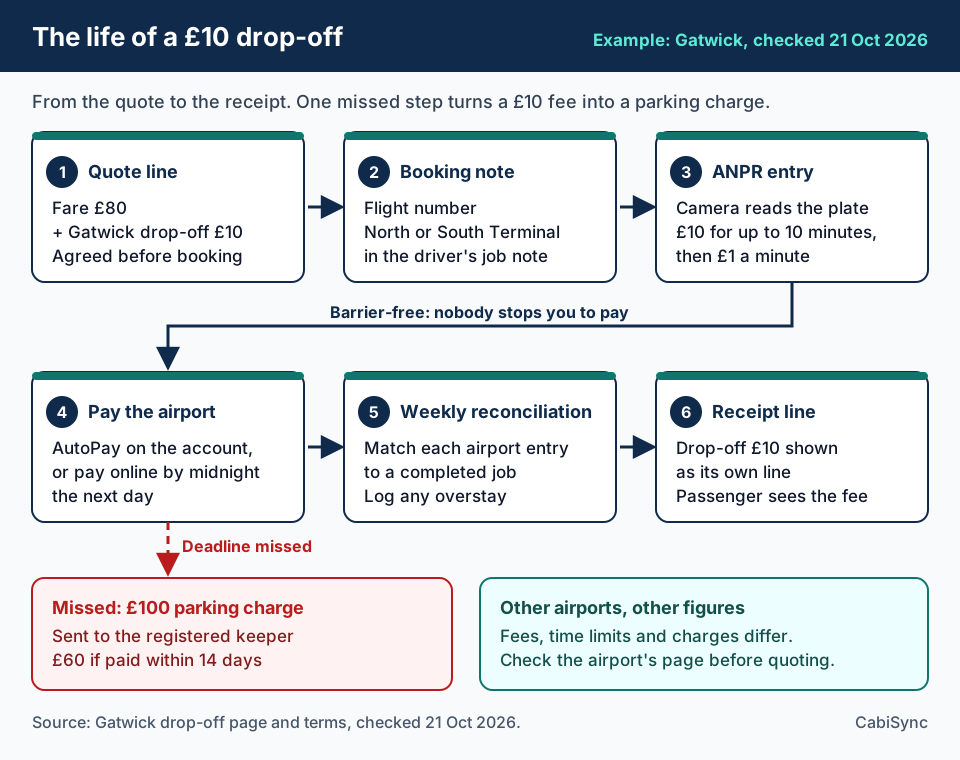
Airport runs carry a drop-off charge at most UK airports, and taxis and private hire vehicles are not exempt. See our airport drop off charges guide for operators for current fees, AutoPay accounts and how to show the fee on the quote.
8. Test booking and dispatch before launch
A booking system needs to help your office answer practical questions: what work has been accepted, which jobs need a driver, whether the driver can reach the pickup, whether the vehicle is suitable, and whether the journey has been completed and paid.
CabiSync supports booking management, dispatch, drivers, recurring contracts and invoicing, helping operators organise these parts of daily work.
Run a realistic dispatch rehearsal
| Scenario | What to check |
|---|---|
| Passenger changes pickup time | The revised time reaches the office and driver |
| Driver becomes unavailable | The booking is reassigned and the customer is updated |
| Airport party has extra luggage | Vehicle suitability is checked before confirmation |
| Recurring journey is cancelled for one day | Other scheduled journeys remain correct |
| Account passenger pays cash | The journey is reconciled without duplicate billing |
| Driver reports a no-show | Staff follow a documented contact and charging process |
Test the handover between shifts too. The next dispatcher should be able to understand unresolved bookings without relying on the previous person’s memory.
Private hire operators have booking record obligations. Confirm required information and retention periods with your licensing authority. Government standards explain operator record keeping.
Protect passenger and driver information, and check whether you need to pay the ICO data protection fee.
Explore CabiSync taxi dispatch for your planned workflow. For a small launch, a clear process may be enough; choose software when the workload justifies it.
9. Win regular customers with a clear offer
Make your website explain where you operate, what you provide and how to book. Then approach organisations whose needs match your capacity.
Give a hotel a booking process it can use
A hotel needs more than your telephone number. Its reception team may need to know how to request and confirm a booking, how much notice you need, whether larger vehicles are available, what happens if a guest is late, who pays and who to contact if the driver is delayed.
Give reception a simple booking process and realistic service commitments. Start with work you can cover, review how it goes and expand the arrangement when it is dependable.
Track the source of bookings. A channel producing repeat local customers may be more useful than one generating enquiries outside your service area.
For school transport or other contracts, check procurement, safeguarding, vehicle and service requirements before bidding.
10. Review the business before expanding
Look beyond total revenue. Track completed bookings, unfulfilled requests, driver availability, contribution by journey type, complaints, repeat customers and unpaid invoices.
Example: use lost bookings to guide recruitment
| Reason you could not accept work | Possible response |
|---|---|
| No driver at the requested time | Recruit for that shift |
| No suitable larger vehicle | Assess demand before adding capacity |
| Pickup outside your area | Review whether expansion is practical |
| Customer declined the quote | Check costs, positioning and enquiry quality |
| Too little booking notice | Improve capacity or clarify booking expectations |
If most lost work occurs during weekday mornings, adding weekend drivers will not solve the problem. Use a short weekly review to decide the next action. Expand when demand, staffing and cash support it.
Frequently asked questions
Can I start a taxi business with one car?
Yes, subject to the required licences and approvals. Plan how you will handle time off, breakdowns and overlapping requests. Confirm bookings only when you have suitable capacity.
Do I need to own vehicles to start a taxi company?
Your model may use company vehicles, owner-drivers or both, subject to appropriate licensing and operating arrangements. Compare the cost and control of each approach before deciding.
How do I recruit private hire drivers?
Advertise the coverage you need and explain charges, payments, allocation and document requirements. Use a consistent onboarding process and make sure your operation offers drivers dependable administration.
How much does it cost to start a taxi business?
It depends on the business model and location. Build a budget from actual licensing, insurance, vehicle and supplier quotes, then add working capital for the period before customer payments arrive.
Do I need an operator licence if I drive myself?
In England and Wales, accepting your own private hire bookings generally requires an operator licence as well as appropriate driver and vehicle licensing. Working through another licensed operator is a different arrangement. Confirm your proposed setup with the licensing authority.
Launch with a business you can run consistently
Before accepting your first booking, check:
- Are the business, driver and vehicle appropriately licensed?
- Is a suitable driver available for the full journey?
- Does the fare cover the work involved?
- Can the office manage changes and delays?
- Will completion, payment and driver earnings be recorded correctly?
Book a CabiSync demo to discuss organising taxi bookings, coordinating drivers, managing recurring work and keeping invoicing connected to your operation.
Last reviewed: 17 October 2026. Licensing conditions vary by location; confirm the requirements for your proposed operation with the relevant authority.