Seat belts
Do taxi drivers have to wear seat belts? A shift behind the wheel
At a glance
Do taxi drivers have to wear seat belts? Learn the UK exemptions, passenger rules and child-seat checks through a working shift. Read the practical guide.
Use the contents below to find the part you need.
Do taxi drivers have to wear seat belts? Usually, unless a specific exemption applies. Private hire drivers must belt up on empty pickup journeys; their work exemption applies while carrying a passenger for hire. Licensed taxis have a broader exemption for specified hire activities. Check the official exemptions.
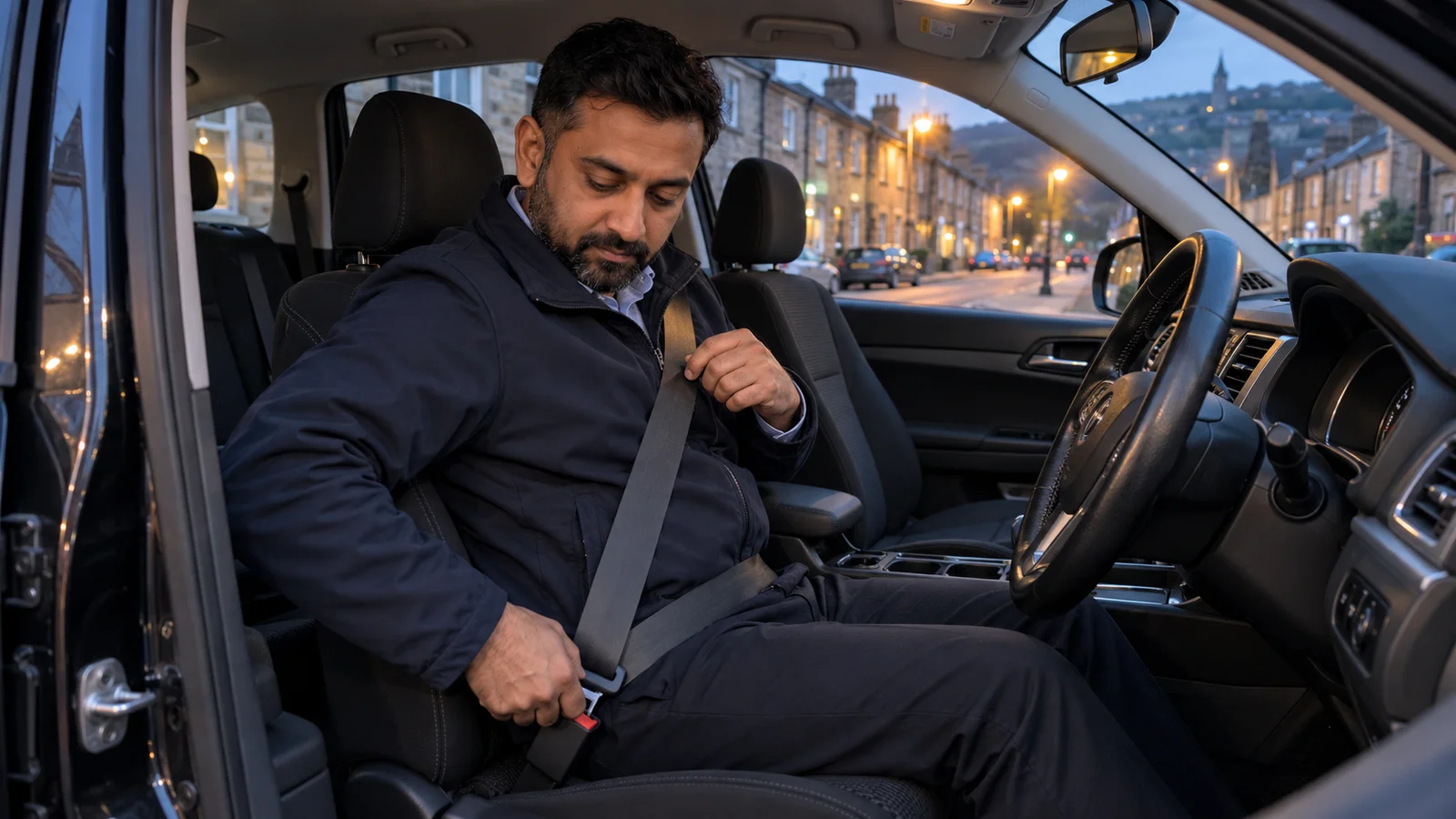
At 5:40am, Imran leaves home for his first airport pickup. His private hire badge is current, the vehicle is licensed and the booking is confirmed.
He pulls away without fastening his seat belt.
“I’m working,” he thinks. “Taxi drivers are exempt.”
His first mistake happens before the passenger opens the door.
Private hire drivers must wear a seat belt when driving empty to a pickup. Their work-related exemption applies while carrying a passenger for hire. Licensed taxi drivers have a broader exemption that also covers certain activities connected with seeking or answering a hire. Check the official driver exemptions.
For a taxi office, the useful question is what happens as the job changes: on the way to a pickup, with passengers aboard and after the last person gets out.
Let’s follow that through a working day.
Imran and the other people in this article are fictional. Their situations illustrate decisions drivers and operators may encounter.
5:40am: the booking is confirmed, but the car is empty
Imran’s passenger is waiting at a hotel ten minutes away. The job is on his screen, and he has already told the office he is on his way.
That does not make the passenger present.
For private hire work, an allocated booking and a passenger aboard are different situations. Driving towards the customer does not activate the passenger-carrying exemption.
A useful instruction for a PHV driver briefing is:
Before moving off for a pickup, fasten your belt. A confirmed booking does not change the empty journey.
This also avoids confusing private hire drivers with hackney carriage drivers, whose exemption is worded differently.
Why “taxi drivers are exempt” is a poor briefing
A mixed fleet might include a hackney carriage, a private hire saloon and an executive PHV. A shared radio channel does not give them a shared rulebook. Calling everyone a taxi driver may be convenient in conversation, but it leaves out a distinction that matters here.
A blanket “taxi drivers are exempt” briefing is inadequate. Failing to wear a belt when required can mean a fine of up to £500, so start with licence type and journey circumstances. GOV.UK sets out that maximum penalty; it is not a prediction of what every case costs.
6:00am: the passenger gets in
Imran reaches the hotel. His passenger puts a suitcase in the boot, takes a rear seat and closes the door.
During the private hire journey, the driver’s passenger-carrying exemption applies. Wearing a belt remains an available safety choice.
The passenger, however, has a separate responsibility.
“Do I need this?” she asks, holding the buckle. “I thought nobody needed a belt in a taxi.”
A straightforward reply is:
“Please fasten it before we leave. The driver exemption doesn’t extend to passengers.”
Passengers generally need to wear a seat belt where one is fitted, unless they have their own applicable exemption. Passengers aged 14 and over are responsible for wearing theirs; the driver has responsibility for children under 14 where restraint rules apply. See the Highway Code’s responsibility table.
Give drivers a calm response to refusal
Your office should have a procedure for a passenger who refuses.
A practical starting point is to keep the vehicle stationary, explain the requirement and contact the office if the disagreement continues. Drivers should follow the operator’s procedure and applicable licensing conditions, without turning a safety reminder into an argument.
6:50am: the passenger leaves, and the next job arrives
At the airport, Imran unloads the suitcase and closes the boot. Another booking appears nearby.
This is an easy moment to overlook the belt. The first journey has ended, but the working day continues without a pause.
For a private hire driver, the passenger-carrying exemption no longer applies once the passenger has left.
Build the reminder into the departure routine:
Passenger out → check the next job → belt fastened → move off.
An operator can reinforce this during onboarding by asking a simple scenario question:
“You have just dropped someone off, and your next passenger is two streets away. What do you do before driving?”
Use the scenario in your driver onboarding and document workflow. Ask for the action before asking for a signature.
What changes for a licensed taxi driver?
Licensed taxi drivers have an exemption covering specified hire activities. Official guidance includes plying for hire, such as waiting at a rank or looking for street hails, as well as carrying passengers.
Private hire drivers cannot assume that waiting for a booking gives them the same exemption.
| Situation | Private hire driver | Licensed taxi driver |
|---|---|---|
| Personal journey, with no other exemption | Wear a belt | Wear a belt |
| Driving empty to a booked pickup | Wear a belt | Separate taxi exemption wording applies to answering a hire |
| Carrying a passenger for hire | Driver exemption applies | Driver exemption applies |
| Lawfully plying for hire | PHVs cannot ply for hire | Taxi exemption applies |
| Passenger aged 14 or over | Passenger generally wears their own belt | Passenger generally wears their own belt |
For unusual hackney carriage circumstances, particularly work outside the licensing area, check the applicable legal wording and obtain appropriate clarification. A short office chart should not invent a universal answer for every journey.
10:15am: “two adults and the children”
Back at the office, dispatcher Aisha takes an airport booking.
“How many passengers?”
“Two adults and the children.”
She enters “family booking” and moves on.
At pickup, the driver discovers a two-year-old, a five-year-old, two suitcases and a pushchair. Nobody has discussed child seats.
The problem began with an incomplete booking.
Ask questions that change the allocation
For a family booking, establish:
- The number of adults and children.
- Each child’s age.
- Relevant height or size information when arranging a restraint.
- Whether the family is bringing suitable child seats.
- Whether the operator has actually confirmed providing a seat.
- Luggage and pushchair requirements.
“Child seat requested” and “suitable child seat confirmed” should mean different things in the office.
Compare these notes:
Unclear: Family, two children, airport.
Useful: Two adults; children aged two and five. Customer bringing suitable restraints. Two large suitcases and folding pushchair. Confirm vehicle fit and allow installation time.
Keep booking information relevant and share it only with staff and drivers who need it.
Can children travel in a taxi without a car seat?
There is a specific exception for licensed taxis and private hire vehicles when the correct child seat is not provided.
In that situation, children can travel without the correct child seat in the rear:
- Children under three can travel without a seat belt.
- Children aged three or over must use an adult belt.
This exception does not mean travelling without an appropriate restraint is the safest arrangement. Planning suitable seats remains the better approach. Read the official taxi and minicab child-seat rules.
Example: the child seat arrives, but the luggage no longer fits
Suppose the office confirms two suitable child seats for a family airport transfer. A saloon has enough passenger positions, but the suitcases and pushchair exceed its usable luggage space.
The booking still needs attention.
Confirm the complete load before allocating: passengers, restraints and luggage. A passenger-capacity figure cannot answer all three questions.
Avoid blanket advice about the front seat
“Children can never sit in the front” is too broad. The correct restraint depends on age and size, and the taxi exception for a missing child seat concerns rear-seat travel.
A rear-facing child seat must not be used in front of an active passenger airbag. The Highway Code explains child restraints and airbag precautions.
2:30pm: the buckle hidden beneath the seat cover
Before his afternoon work, Imran checks the rear seats. One buckle has slipped beneath a fitted cover.
Yesterday’s passenger might have found it. Today’s passenger might assume there is no usable belt.
Make access part of the vehicle check. Confirm that belts are visible, accessible and free from obvious damage, and that buckles work correctly. Follow the appropriate inspection process for the vehicle.
If a belt is defective, report it and follow the maintenance and allocation procedure. Include restraint checks in your vehicle inspection routine. Do not leave the next passenger to discover the problem.
What should the taxi office change?
A useful seat belt policy should help staff make decisions during a busy shift.
Add three questions to driver onboarding
- What licence type are you working under?
- When does the relevant driver exemption apply?
- What do you do when a passenger or family booking raises a restraint problem?
Make family requirements part of confirmation
Before promising a vehicle or child seat, check availability and suitability. Give the customer a clear confirmation rather than relying on a request buried in notes.
Review the booking when a complaint arrives
Suppose a parent complains that the driver arrived without the promised booster. Check the booking trail:
- Was it requested?
- Did the office confirm it?
- Was a suitable vehicle allocated?
- Did the driver receive the requirement?
- Was a later change communicated?
That review identifies where the process failed and what needs fixing. Keep requirements visible in the booking and dispatch workflow. A clear booking template may be enough; a missing question does not always need new software.
Frequently asked questions
Do Uber and other app-based private hire drivers have to wear seat belts?
The app does not determine the exemption. For private hire drivers, driving empty to collect someone requires a belt unless another applicable exemption exists. The work-related exemption concerns carrying a passenger for hire.
Do taxi passengers have to wear seat belts?
Generally, yes, where fitted and unless an applicable exemption exists. The driver’s exemption does not automatically cover passengers.
Who is responsible for a child’s seat belt?
The driver is responsible for children under 14 where the restraint requirement applies. Having a parent in the car does not automatically transfer that responsibility. See the Highway Code.
Can you be fined for not wearing a seat belt?
Yes. GOV.UK states that failing to wear one when required can result in a fine of up to £500. Check the current penalty guidance.
Does this guide cover Northern Ireland?
The examples focus on Great Britain. Northern Ireland has separate legislation. Operators there should use nidirect’s seat belt guidance.
Make the next departure easier to get right
Imran’s day involved an empty pickup, an airport drop-off, a family booking and a vehicle check.
Those ordinary moments are where a clear process helps.
Give drivers instructions that match their licence type. Confirm family requirements before allocating a vehicle. Make sure passengers can reach a working belt. Review complaints against what was actually booked and communicated.
Explore CabiSync to discuss how your office manages bookings, drivers and the information needed to prepare each journey.
Last reviewed: 17 October 2026. By the CabiSync Editorial Team.