Safeguarding
Cross-border hiring for UK private hire operators
At a glance
Cross-border hiring for UK private hire operators: triple lock, booking acceptance vs job geography, sub-contract records, and roadside signals from Barnsley and South Gloucestershire. Office checklist included.
Use the section links to find the rules, office actions and sources.
Cross-border hiring for UK private hire operators is under sharper enforcement and reform pressure than many offices realise. Your office must know which licences cover which jobs — the operator–driver–vehicle "triple lock" — where each booking is accepted, and what happens when you pass work to a partner fleet. Barnsley and South Gloucestershire roadside stops show condition, plate and document failures travel with the vehicle. Pressure for national standards and a national licensing database is rising. This is not legal advice. Confirm live DfT, GOV.UK and your licensing authority's rules before you change process.
Why This Matters Now
Out-of-area hiring now sits on roadside stop sheets, mayor briefings, Transport Committee recommendations, and ride-hail signals that favour local compliance. A passenger books through your brand; the job may run outside your district; the driver or vehicle may sit on another council's plates — or you pass the job to another operator. When officers stop the car, they ask for documents you should already hold.
The Clear Problem
You know who took the call — but not always which operator licence accepted the booking, which driver and vehicle licences cover that job, or whether a sub-contract moved it. You know the pick-up postcode — but not always how geography maps to licensing areas and local conditions.
Cross border private hire in England (outside London) is often described in trade coverage as lawful where bookings are accepted through an appropriately licensed operator, even if the journey runs outside the licensing district. Councils, mayors and MPs are pressing ministers to curb that practice. You need an audit trail now — not after a Bill.
Rules and Requirements (With Primary Sources)
Treat this as a working map. National guidance and council policies differ. Separate national / DfT material from your own council's licence conditions. Confirm live pages on the day you decide.
1) Triple Lock: Operator, Driver, Vehicle
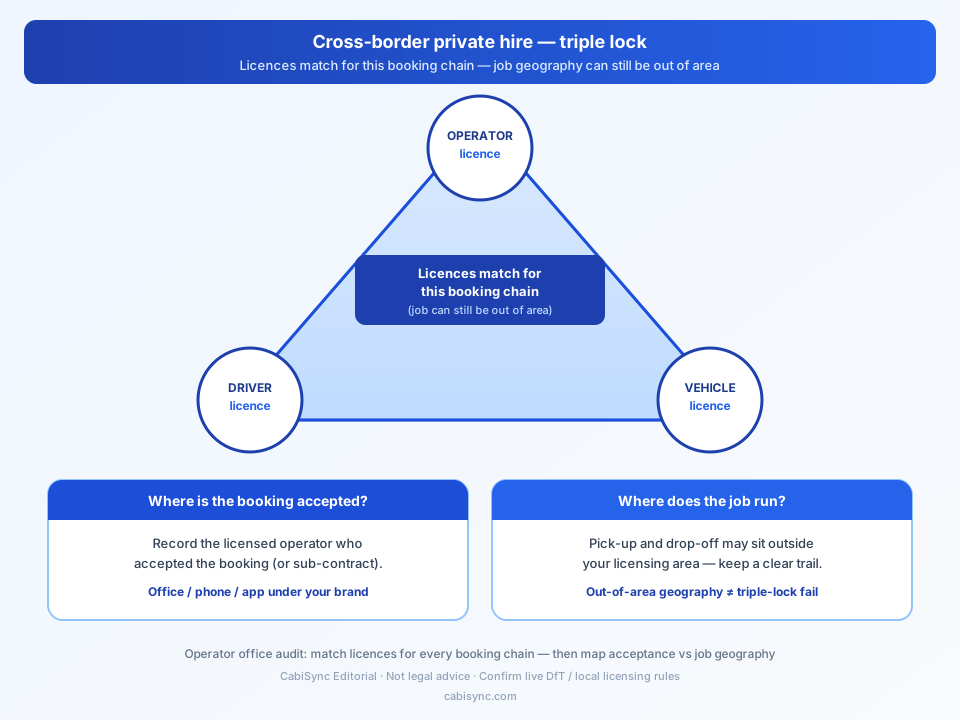
For private hire work outside London, the classic picture is a "triple lock": a licensed operator accepts the booking, and the driver and vehicle used are a valid matching set for that booking chain:
- The operator licence under which the booking is accepted
- The driver licence of the person who does the job
- The vehicle licence of the car that runs the job
Triple lock means licences match for this booking chain — not that every mile must stay inside one council area. Job geography can still be out of area. If any leg is missing, mismatched, or unexplained after a sub-contract, you have an audit problem before you have a roadside problem.
Lean on DfT's non-statutory Taxi and private hire vehicle licensing best practice guidance (updated 17 November 2023), the Statutory Taxi and Private Hire Vehicle Standards (authorities must have regard to them), and enforcement reporting (TaxiPoint / PHTM). The separate PHV licensing guidance note is mainly about what is and is not a PHV — not a cross-border primary.
2) Where the Booking Is Accepted vs Where the Job Runs
Two questions for every office wall:
- Where was the booking accepted? (Your office, or a sub-contracted operator?)
- Where does the job run? (Pick-up, drop-off, significant waits.)
Trade reporting on Barnsley's July 2026 operation restates the practical framing: a PHV may undertake work outside its licensing area if bookings are accepted through an appropriately licensed operator — and out-of-area enforcement often needs council cooperation. Record both geography and licence identity.
3) Sub-Contracting Between Licensed Operators
In England outside London (and outside Plymouth's separate regime), operator-to-operator sub-contracting has a live statutory footing: Deregulation Act 2015 s.11 inserted ss.55A–55B into the Local Government (Miscellaneous Provisions) Act 1976. A licensed operator who has accepted a booking may arrange for another licensed operator (same or another district, a London PHV operator, or acceptance in Scotland) to provide a vehicle — with residual criminal liability if the first operator knew the second would breach driver/vehicle licensing requirements.
That is not a blank cheque. Your local operator conditions and booking-record rules still bind you. Check your licensing authority's conditions and take advice for your model. Do not treat this guide as permission to sub-contract out-of-area work.
Before you pass a booking: record acceptance under your operator licence (if you accepted it); record the sub-contract (partner name, licensing authority, time, reference); confirm the partner will use a driver and vehicle that match their licensing framework for that booking chain; inform the passenger where required; keep a trail from phone/app to car. A WhatsApp ping is not a compliance file.
4) Local Licensing Conditions Still Bind You
National reform talk does not cancel today's conditions. Neighbouring councils may jointly authorise enforcement officers to act on vehicles licensed elsewhere; DfT best practice encourages that cooperation.
5) Reform Bill, National Standards and National Database (Not Yet Law)
Ministers and Parliament are pushing change. That does not mean the Reform Bill is already in force. Treat reform as a planning horizon.
- The Commons Transport Committee report "Raising the standard" (9 June 2026), summarised by the Institute of Licensing, called for a plan to curb extensive out-of-area working, high national minimum standards, stronger police–licensing information sharing, and a national database of drivers, vehicles and operators.
- Local Transport Minister Lilian Greenwood confirmed the forthcoming Taxi and Private Hire Vehicle Reform Bill has authority for pre-legislative scrutiny — modernising booking-app law, stronger enforcement, a mandated national database, accessibility and safeguarding responses.
- Transport Secretary Heidi Alexander told the Commons she believes drivers and operators should be licensed where they intend to provide services, while looking at out-of-area working holistically (TaxiPoint).
Until a Bill and regulations take effect, run to current law and council conditions. Build records that will sit cleanly against a future national database.
6) Market and Political Signals: Local Compliance and Regional Pressure
Platform and mayor signals shape how your town feels about out-of-area plates — but they are not a hard national "local licences only" legal rule.
- Bolt Liverpool: PHTM (2 September 2026) reported Bolt's Liverpool launch as a fully compliant platform where drivers need to maintain all local compliance regulations, per senior GM Kimberly Hurd — platform choice and market signal, not statute.
- Greater Manchester: PHTM reported mayor Bev Craig as hopeful of powers so PHVs working in GM must be licensed locally.
- Fleet concentration: TaxiPoint Magazine Edition 89 (September 2026) cited DfT figures: Wolverhampton held about 37,967 licensed PHVs (~13.1% of England's fleet).
These are not your bye-laws. They are the climate officers and passengers already feel.
Step-by-Step: Cross Border Private Hire Office Runbook
Use this as a weekly office drill.
Step 1: Pin the Triple-Lock Questions
Print the diagram. For every disputed or out-of-area job ask: which operator licence accepted the booking; which driver licence covers the person in the seat; which vehicle licence covers the car. If the answer is "we think so," fix the file before the next shift.
Step 2: Map Your Work Geography
Sarah Ahmed runs CityLink Cars from a South Yorkshire district. Daytime work stays mostly local; weekend nights spill into neighbouring towns. Manager Michael Brown maps frequent pick-up zones and tags boundary-crossing jobs for deeper document checks — because enforcement attention is higher there, not because every cross-border mile is unlawful.
Step 3: Separate "Our Drivers" from "Sub-Contract Partners"
Keep two lists: drivers/vehicles under your operator name (full packs); and partner operators you pass bookings to (details, written process, licence confirmation). Night supervisor David Khan passes a late airport job to QuickRide Taxis and logs time, booking reference, partner name, licensing authority, and acceptance confirmation.
For airport jobs, also agree who pays the drop-off charge and whose AutoPay account the partner's vehicle is on. See airport drop off charges for operators.
Step 4: Build a Roadside-Ready Document Pack
Produce quickly for every live driver: operator licence and booking record; driver badge/licence and expiry; vehicle plate/licence, MOT/compliance test, insurance; signage/condition expectations; sub-contract trail if passed.
Step 5: Audit Ten Jobs Every Friday
Include at least three boundary-crossing or sub-contracted jobs. Tick acceptance, matching licences, sub-contract details, pack in date, defects closed. One Friday Michael found a sub-contract with no partner reference and closed the gap the same day.
Step 6: Train Dispatch, Not Just the Licence Holder
Brief dispatchers for 20 minutes: triple lock; when your office accepts a job; how to log a sub-contract; pause rather than guess if a partner cannot confirm licences. An empty hackney outside its licensed area cannot seek hire, so the driver must belt up — seat belt exemptions differ by licence type and area.
Step 7: Watch Reform Without Freezing Operations
One person skims IoL, TaxiPoint and PHTM Reform Bill summaries each month. Do not rewrite process on rumour — upgrade records so a future national database ask does not panic the office.
Triple-Lock and Sub-Contract Audit Checklist
A) Triple Lock — Every Job You Keep In-House
- Operator licence current and available as required locally
- Booking accepted under this operator licence (time, channel, staff ID)
- Driver PH / taxi licence sighted, copied, expiry diaryed
- Vehicle PH / taxi licence sighted, copied, expiry diaryed
- Driver and vehicle licences are a valid matching set with the accepting operator for this booking chain
- Insurance, MOT / compliance test, and plate / signage expectations checked
- Walkaround / defect process understood by the driver
- Dispatch blocked if any of the above is missing or expired
B) Sub-Contract — Every Job You Pass
- Original booking acceptance recorded under your operator licence (if you accepted it first)
- Written or system record of sub-contract to named partner operator
- Partner's licensing authority and operator licence reference stored
- Partner confirms correctly licensed driver and vehicle for that booking chain
- Passenger communication completed where required
- Booking reference shared both ways
- Partner remains on your approved list (review quarterly)
- Local licensing conditions and advice checked — this checklist is not permission to sub-contract
C) Geography and Enforcement Readiness
- Frequent out-of-area zones mapped
- Staff know multi-agency roadside checks happen (Barnsley / South Glos pattern)
- Document packs printable or viewable in under two minutes
- Named owner for booking-record audits
D) Reform Horizon (Planning Only — Not Current Law)
- Team briefed: Reform Bill / national database proposals are in progress, not in force
- Records already capture operator, driver, vehicle and booking acceptance
- No process change on unverified "ban" claims
Common Mistakes That Create Enforcement Risk
1) Treating "Out of Area" as "Someone Else's Problem"
CityLink works a neighbouring town every weekend. Joint ops show home and neighbouring authorities work together — your records must travel with the job.
2) Badge-Only Thinking Without Operator Acceptance
Valid badge and plate mean little if nobody can name which operator accepted the booking.
3) Soft Sub-Contracts With No Paper Trail
QuickRide and CityLink swap Friday overflow by phone with no partner licence log. A complaint arrives and neither office can prove the chain.
4) Ignoring Vehicle Condition and Signage on Partner Fleets
Barnsley's 18 July 2026 night operation stopped 43 hackney and private hire drivers/vehicles with Barnsley, South Yorkshire Police, Bradford and Wolverhampton licensing teams. Bradford officers suspended two Bradford-licensed PH drivers and vehicles for signage and accident-damage breaches; local vehicles were largely compliant. (TaxiPoint)
5) Assuming High Compliance Elsewhere Means You Can Skip Packs
South Gloucestershire's 12 August 2026 morning operation with police and teams from Bristol, Wolverhampton, Newport and Tewkesbury stopped 108 vehicles from 26 licensing areas. Two stop notices halted unsafe vehicles; overall compliance was high. (PHTM)
6) Confusing Reform Talk With Today's Rules
David tells drivers "out of area is banned from Monday" after reading mayor headlines. Reform proposals are not your current licence conditions.
7) No Owner for Booking Records
Nominate a person. Diary a weekly sample check.
8) Treating Multi-Force Checks as Rare
Wolverhampton's Northern Compliance Team worked with GMP, Cheshire Police and Merseyside Police over a Bank Holiday weekend — TaxiPoint reported high compliance but no published counts. Expect routine out-of-area checks.
9) Keeping Expired Documents in "Active" Folders
One lapsed badge or test at an out-of-area stop is harder to explain than the same lapse at your own rank.
Related Operator Compliance Tasks
Cross-border hiring sits beside: Right to Work Checks for Private Hire Operators, Enhanced DBS Check for Taxi Drivers, Private hire operator licence: hard stops after 205 jobs on an expired badge, Taxi MOT Rules, and CabiSync compliance features.
Frequently Asked Questions
Is cross-border private hire work already banned?
No. Trade and enforcement reporting still describe PHVs undertaking work outside their licensing area where bookings are accepted through an appropriately licensed operator. Political pressure aims to curb extensive out-of-area working. That is not a live nationwide ban. Confirm your local conditions.
What is the "triple lock" in plain English?
The operator, driver and vehicle licences that cover a private hire job must be a valid matching set for that booking chain. Job geography can still be out of area. If you cannot name all three, stop and fix the trail.
Can I sub-contract a booking to an operator in another district?
In England outside London (and outside Plymouth), LG(MP)A 1976 ss.55A–55B (inserted by Deregulation Act 2015 s.11) allow licensed operators to sub-contract bookings to other licensed operators, including in another district. Local conditions still apply; the first operator can face criminal liability if they knew the second would breach driver/vehicle licensing rules. Check your local licensing conditions and take advice — do not treat this guide as permission to sub-contract out-of-area.
Why do Barnsley and South Gloucestershire matter to my office?
Recent multi-agency roadside examples. Barnsley (18 July 2026) stopped 43 vehicles and suspended two Bradford-licensed PH drivers/vehicles for signage and accident damage. South Gloucestershire (12 August 2026) checked 108 vehicles from 26 areas and issued two stop notices.
Will a national licensing database change my day-to-day?
If delivered as described, thin office records become more obvious. Build clean records now — do not claim the database already exists.
What did the Transport Committee recommend on out-of-area working?
"Raising the standard" (9 June 2026), as summarised by the Institute of Licensing, called for a plan to curb extensive out-of-area working, high national minimum standards, stronger information sharing, and a national licensing database. Committee report, not legislation.
Does Bolt's Liverpool stance change the law?
No. Platform choice and market signal — Hurd framed a fully compliant platform where drivers need to maintain all local compliance regulations. Not a hard national "local licences only" legal rule. Your duties still come from legislation, your operator licence, and your licensing authority.
Is this legal advice?
No. Confirm live GOV.UK / DfT material and take professional advice for your circumstances.
What to Do Next
- Pin the triple-lock diagram and walk new dispatchers through it.
- Audit ten recent jobs (include cross-boundary and sub-contracts); close missing acceptance records this week.
- Refresh partner operator files — authority, details, short written process.
- Run a 20-minute briefing using Barnsley and South Glos as "what roadside looks like."
- Separate today's rules from Reform Bill headlines — pre-legislative scrutiny is not statute.
- Tie cross-border checks to the same expiry diary as badges, DBS and MOTs.
Worried your booking, sub-contract or document packs would not survive a multi-agency stop? Book a free 15-minute compliance review — acceptance records, licence matching and roadside-ready packs. Your radio room and dispatch stay as they are.
CabiSync’s published guide prices are Starter £29 and Professional £42 per active driver per week, for fleets with up to 20 active drivers. Confirm plan scope and availability during a demo. See the pricing guide.
This article is not legal advice. Always confirm live GOV.UK and DfT material, and seek professional advice for your circumstances. Last reviewed 9 September 2026 by the CabiSync Editorial Team.