London PHV rules
TfL's 2028 electric-only plan for new PHVs: what London private hire operators should check now
At a glance
TfL PCO car requirements now and proposed: new PHVs fully electric from 3 July 2028, a hard 10-year cut-off from March 2027. Respond by 2 Dec.
Use the section links to find the rules, office actions and sources.
By the CabiSync Editorial Team · Last reviewed 5 November 2026
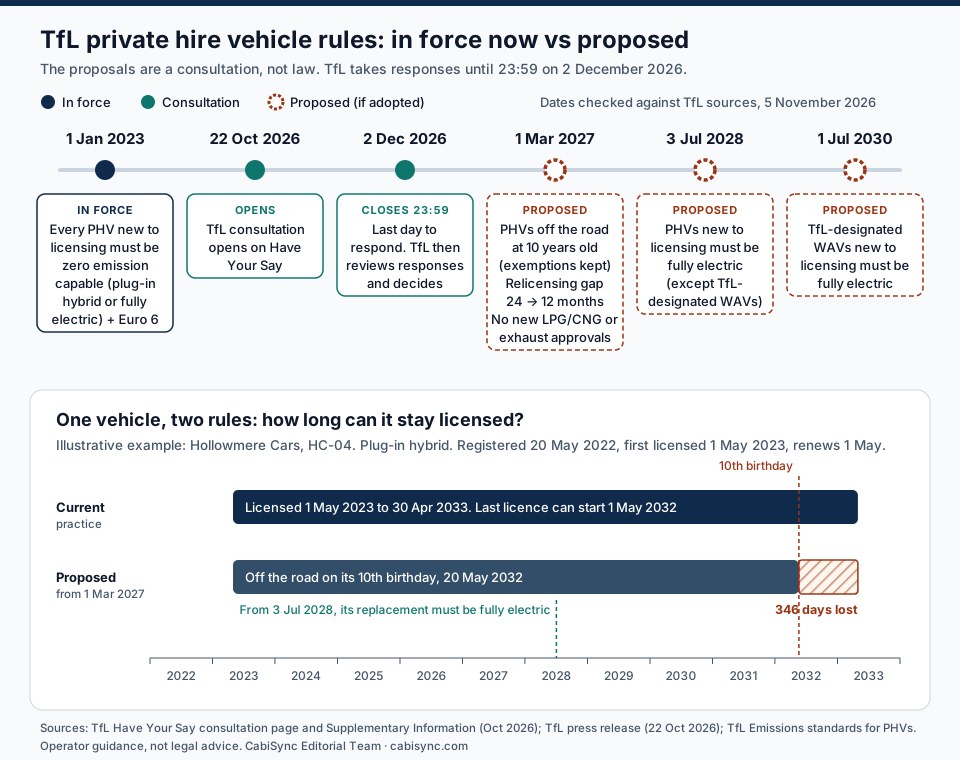
Direct answer: Today, a car newly licensed as a London private hire vehicle ("PCO car") must be a plug-in hybrid or fully electric. TfL proposes fully electric only from 3 July 2028, and removing PHVs on their age-limit birthday (the 10th for most) from 1 March 2027. This is a consultation, closing 2 December 2026. Record each car's fuel type and first-registration date now.
We checked every date and figure in this guide against TfL's own consultation page, its Supplementary Information document, its draft Integrated Impact Assessment and its 22 October 2026 press release on 5 November 2026. Where TfL's documents do not answer a question, we say so.
Why this matters now
- The clock is short. The consultation opened on 22 October 2026 and closes at 23:59 on Wednesday 2 December 2026. That is six weeks. The first changes would start on 1 March 2027, three months later.
- About a third of London's PHVs are plug-in hybrids. In September 2026, TfL licensed 94,661 PHVs. 35.5% were fully electric and 35.2% were plug-in hybrids. A plug-in hybrid can stay licensed under the proposals. But a plug-in hybrid could not be licensed for the first time from 3 July 2028.
- Many drivers are still buying plug-in hybrids. TfL says 39% of PHVs new to licensing in the last 12 months were fully electric. Almost all the rest will have been plug-in hybrids, because those are the only other cars TfL accepts, apart from a few exemptions. A driver who buys one this winter can keep it to its age limit. Their next car, if it is licensed after 3 July 2028, would have to be fully electric.
- The age rule bites sooner. Today a PHV can stay licensed up to the day before it turns 11. Under the proposal it comes off the road on its 10th birthday. Depending on your renewal date, that can cost a car up to a year of work.
- Your capacity depends on your drivers' cars. TfL's draft impact assessment says 86% of private hire drivers are self-employed. Many affiliated drivers choose and replace their own cars. If those cars drop out, your fleet shrinks, whatever your booking volume.
- The trade is split. Steve Wright, chair of the Licensed Private Hire Car Association (LPHCA), told BBC London the plans were "not achievable". He said "most PHV drivers generally don't have the ability to charge vehicles at home". Zak Bond of Clean Cities told the BBC that "a clear deadline gives drivers confidence to plan their next purchase". Whatever your view, the consultation is where it counts.
The problem in your office
Most operators know roughly how many electric cars they dispatch. Few know, car by car, when each one stops being licensable. That is the gap these proposals expose.
- First-registration dates are not on file. TfL measures a PHV's age from the date it was first registered with the DVLA. That date is on the V5C. Many offices only hold the PHV licence expiry date.
- Renewal dates and birthdays do not line up. A car whose licence renews a few weeks before its 10th birthday loses almost a full year under the proposal. A car that renews just after its 9th birthday loses very little.
- Replacement plans are unknown. You may not know which drivers plan to change cars in 2027 or 2028. A replacement licensed on or after 3 July 2028 would need to be fully electric.
- Lapsed licences get forgotten. A driver off sick lets the vehicle licence expire. If the gap goes past TfL's limit, the car is treated as new to licensing. After 3 July 2028, that would mean a plug-in hybrid could not come back.
- Wheelchair accessible vehicles are scarce already. TfL says only 361 PHVs, 0.4% of the fleet, were wheelchair accessible vehicles (WAVs) in September 2026. Losing one WAV can mean losing a contract.
The rules and primary sources: current vs proposed
TfL licenses London PHVs under the Private Hire Vehicles (London) Act 1998 and the Private Hire Vehicles (London PHV Licences) Regulations 2004. The table below shows what applies today and what TfL proposes. Only the left-hand column is in force.
| Topic | In force today | Proposed by TfL (consultation to 2 Dec 2026) |
|---|---|---|
| Vehicles new to licensing | Since 1 January 2023, every PHV licensed for the first time must be zero emission capable (ZEC) and Euro 6. ZEC means no more than 50g/km CO2 with at least 10 miles of zero-emission range, or no more than 75g/km with at least 20 miles. Plug-in hybrids and fully electric cars both qualify. | From 3 July 2028, every PHV presented for licensing for the first time must be fully electric, except TfL-designated WAVs. |
| Wheelchair accessible PHVs new to licensing | ZEC rule applies. Eligible WAVs used for specialist work can apply for an exemption from the plug-in hybrid requirement if they meet Euro 6 and no suitable plug-in hybrid is available. | From 1 July 2030, TfL-designated WAVs new to licensing must be fully electric. |
| Age limit | 10 years, counted from first DVLA registration. A licence can be granted for up to 12 months if the car is not over 10 at the point of grant. In practice, TfL says, a PHV can stay licensed up to the day before it is 11. | From 1 March 2027, a PHV cannot be licensed or remain licensed once it reaches 10. TfL says it "would therefore be removed from service on the day it reaches its age limit". Applies to all licensed PHVs, fully electric ones included. |
| Age exemptions | Pre-defined categories: alternative fuel conversions, historic, classic and niche vehicles, specialist needs transport, WAVs and Blue Badge Driver Guides. Others (disabled drivers, specialist adaptations) are case by case. They normally allow up to five more years, to a maximum of 15. | Existing exemptions stay, and remain open to new applications. But a vehicle could not stay licensed beyond the day it reaches its extended age limit. |
| Gap between an expired licence and a new one | Up to 24 months, but only in exceptional circumstances outside the owner's control (TfL Vehicle Inspection Manual, TPH Notice 09/11). Otherwise it is a new application. | From 1 March 2027, 12 months. After that the vehicle is treated as new to licensing and must meet the rules for new vehicles. Applies to taxis too. |
| Alternative fuel and exhaust systems | TfL approves LPG and CNG conversion systems and exhaust abatement systems. | From 1 March 2027, TfL would stop accepting applications to approve new systems. Vehicles already fitted with an approved system stay licensed to their age limit. Existing system approvals stay valid and can still be bought. Applies to taxis too. |
| Taxis | Separate rules. | Not part of this consultation. TfL's press release says "TfL continues to consider proposals for a zero-emission requirement for London taxis in the future". |
Two more details from TfL's documents matter:
- "Fully electric" means built that way. TfL's Supplementary Information says it means vehicles "originally manufactured, and have Whole Vehicle Type Approval, as a fully electric vehicle". An after-market electric conversion would not count. TfL's press release adds that the rule is "highly likely" to mean fully electric, "but vehicle models may come forward that use alternative, compliant technology".
- TfL gives its own worked example. "A private hire vehicle will need to get a new licence before its ninth birthday to operate into its tenth year." An owner "may choose to surrender their private hire vehicle licence early and have that vehicle inspected before its ninth birthday" to get a 12-month licence that runs up to the 10th birthday.
What TfL's documents do not say yet
We could not find answers to these questions in the consultation page, the Supplementary Information or the draft impact assessment. They are good questions to put to TfL through the consultation's question tool.
- Cars already over 10 on 1 March 2027. A car first registered in late 2016 or early 2017 may be licensed today into its 11th year. Does it lose its licence on 1 March 2027, or keep it until that licence expires?
- Licences that start before 1 March 2027. If a 9-year-old car is renewed in February 2027, will TfL issue a licence that ends on its 10th birthday?
- Licences that lapsed before 1 March 2027. Does the 24-month gap still apply to them, or the new 12 months?
What TfL says the impact will be
TfL's draft Integrated Impact Assessment says the average age of the London PHV fleet is under eight years. TfL's Supplementary Information says it does "not expect" the age change "to affect many vehicle owners", as most replace their car before 10. TfL expects the fleet to be fully electric by 2039 with the change, six years earlier than without it. It forecasts a 9% cut in PHV NOx and a 35% cut in PHV CO2 between 2028 and 2037, and 97% for both between 2038 and 2045. TfL also accepts that the age proposal does not align with paragraph 8.4 of the Department for Transport's best practice guidance, which prefers targeted vehicle requirements to age limits. TfL says it believes its age limits are "appropriate and not arbitrary".
Step by step: get your fleet ready
- Collect the V5C first-registration date for every vehicle you dispatch. Use the V5C, not the model year or the plate. Imported cars count from first registration with the DVLA or in their country of origin (TfL Vehicle Inspection Manual, section 1.2).
- Record the fuel type exactly. Use five labels: fully electric, plug-in hybrid, hybrid (not plug-in), petrol or diesel, and LPG or CNG converted. A "self-charging" hybrid is not a plug-in hybrid.
- Record the current PHV licence start and expiry dates. You need the renewal cycle, not just the expiry date.
- Work out three dates per vehicle. The 10th birthday (first registration plus 10 years). The last day it could be licensed today (the expiry of the last 12-month licence that starts before that birthday). The last day it could be licensed under the proposal (the day before the 10th birthday).
- Flag four groups. Cars already over 10 on 1 March 2027. Cars that reach 10 between 1 March 2027 and 2 July 2028 (their replacements can still be plug-in hybrids). Cars that reach 10 on or after 3 July 2028 (their replacements must be fully electric). WAVs, which work to 1 July 2030 instead.
- Check exemptions early. TfL's PHV licence page says exemption applications "must be submitted within the respective age limits". The Supplementary Information says a WAV owner can apply in the vehicle's "final year of licensing". Diary it a year ahead.
- Talk to each affected driver. Tell them the date their car would drop out and what their next car would need to be. Keep a record that you told them.
- Watch lapsed licences. If a driver stops work, diary the licence expiry plus 12 months. After 1 March 2027, that would be the proposed limit, and only in exceptional circumstances.
- Decide whether to respond to the consultation. Use your audit as evidence. See the checklist below.
- Review again when TfL publishes its decision. TfL says it will publish a consultation report after it has considered all responses.
Fleet audit table and worked example: Hollowmere Cars
Illustrative example: Hollowmere Cars is an invented London operator. It dispatches 42 affiliated vehicles: 17 fully electric cars, 15 plug-in hybrid cars, 8 older hybrids or petrol cars first licensed before 2023, plus 2 WAVs, one of them a plug-in hybrid. All dates below are invented but calculated by TfL's stated rules.
Download the template: TfL PHV fleet audit template (CSV). It has the column headings below, seven worked rows marked EXAMPLE, and 40 blank rows. Delete the example rows before you use it.
Seven vehicles, worked through
| Vehicle | Fuel | First registered | Licence renews | 10th birthday | Last licensed day today | Last licensed day if adopted | Time lost | Replacement must be fully electric? |
|---|---|---|---|---|---|---|---|---|
| HC-01 | Plug-in hybrid | 14 Nov 2016 | 20 Jun | 14 Nov 2026 | 19 Jun 2027 | Unclear. Already over 10 on 1 Mar 2027 | Up to 111 days (1 Mar to 19 Jun 2027) | No. Must still be ZEC |
| HC-02 | Hybrid, not plug-in | 5 Apr 2017 | 1 Oct | 5 Apr 2027 | 30 Sep 2027 | 4 Apr 2027 | 179 days | No. Must still be ZEC |
| HC-03 | Plug-in hybrid | 10 Aug 2018 | 15 Jan | 10 Aug 2028 | 14 Jan 2029 | 9 Aug 2028 | 158 days | Yes (leaves after 3 Jul 2028) |
| HC-04 | Plug-in hybrid | 20 May 2022 | 1 May | 20 May 2032 | 30 Apr 2033 | 19 May 2032 | 346 days | Yes |
| HC-05 | Fully electric | 12 Sep 2023 | 20 Sep | 12 Sep 2033 | 19 Sep 2033 | 11 Sep 2033 | 8 days | Yes |
| HC-06 | Diesel WAV, first licensed 1 Mar 2019 (before the ZEC rule applied to it), age exemption to 15 | 1 Feb 2019 | 1 Mar | 15th birthday: 1 Feb 2034 | 28 Feb 2034 | 31 Jan 2034 | 28 days | Yes (WAV leaves after 1 Jul 2030) |
| HC-07 | Plug-in hybrid, licence lapsed 31 Mar 2027 | 3 Mar 2020 | 1 Apr | 3 Mar 2030 | See below | See below | See below | See below |
How the columns work:
- Last licensed day today is the expiry of the last 12-month licence that starts before the 10th birthday (15th for an exempt WAV).
- Last licensed day if adopted is the day before that birthday, because TfL says the vehicle "would be removed from service on the day it reaches its age limit".
- Time lost is the difference. It depends on how close the renewal date falls before the birthday. HC-04 renews 19 days before its 10th birthday, so it loses almost a year. HC-05 renews 8 days after its birthday each year, so it loses 8 days.
- Replacement must be fully electric is "yes" if the car it would replace leaves on or after 3 July 2028 (1 July 2030 for a TfL-designated WAV), as the replacement would be new to licensing then. If a driver replaces a car early, use the date they plan to license the new one.
HC-07, the lapsed licence. The driver is off sick and the licence expires on 31 March 2027. Under today's rule, TfL can allow up to 24 months to re-license, to 31 March 2029, but only in exceptional circumstances. Under the proposal that limit would be 12 months: 31 March 2028. If the car comes back after that, it is new to licensing. If that happens on or after 3 July 2028, a plug-in hybrid could not be licensed at all.
The whole Hollowmere fleet, by the date each vehicle would leave
| When the vehicle would leave (if adopted) | Vehicles | Fully electric | Plug-in hybrid | Other (hybrid, petrol) | WAV | Replacement must be fully electric? |
|---|---|---|---|---|---|---|
| 1 Mar 2027 (already over 10, treatment unclear) | 3 | 0 | 1 | 2 | 0 | No (ZEC) |
| 2 Mar 2027 to 2 Jul 2028 | 5 | 0 | 2 | 3 | 0 | No (ZEC) |
| 3 Jul 2028 to 31 Dec 2028 | 3 | 0 | 2 | 1 | 0 | Yes |
| 2029 | 5 | 1 | 3 | 1 | 0 | Yes |
| 2030 | 5 | 2 | 2 | 1 | 0 | Yes |
| 2031 | 6 | 3 | 2 | 0 | 1 (plug-in hybrid, no age exemption) | Yes |
| 2032 | 6 | 4 | 2 | 0 | 0 | Yes |
| 2033 | 4 | 3 | 1 | 0 | 0 | Yes |
| 2034 | 3 | 2 | 0 | 0 | 1 (diesel, exempt to 15) | Yes |
| 2035 | 2 | 2 | 0 | 0 | 0 | Yes |
| Total | 42 | 17 | 15 | 8 | 2 | 34 of 42 |
What Hollowmere learns from this:
- 8 vehicles leave before 3 July 2028. Three of them may go on day one, 1 March 2027, depending on how TfL handles cars that are already over 10. That is nearly a fifth of the fleet in 16 months.
- 34 of 42 replacements would have to be fully electric. That includes 12 of the 15 plug-in hybrids and both WAVs.
- Charging becomes a dispatch question. By 2030, most new joiners would be driving fully electric cars. Shift patterns and job lengths would need to fit charging stops.
TfL's draft impact assessment says the average London PHV is under eight years old, but that the age at which PHVs typically stop being licensed "is not known". TfL's Supplementary Information says it expects "most vehicle owners already replace their vehicle before the ten-year age limit is reached". Your mix of ages, fuel types and renewal dates will differ from Hollowmere's, which is why the audit is worth an hour.
Consultation response checklist (your view, your evidence)
You do not need a position to respond. You need facts. The online survey first asks whether you are responding as an individual or as an official representative of an organisation (Q1). It then asks which option best describes you, and "Private hire operator" is one of them (Q4). The survey labels TfL's five proposals A to E: A (3 July 2028), B (WAVs, 1 July 2030), C (conversion and exhaust systems), D (the 10-year rule) and E (the 12-month gap). Its free-text question (Q11) asks you to "indicate which element of our proposal your comment is about", so you can name the proposal letter in your answer.
Tick each line as you prepare your response.
- ☐ Count how many of your vehicles reach 10 between 1 March 2027 and 1 March 2028, and how many days of licensed time they would lose.
- ☐ Count how many plug-in hybrids your drivers bought or leased in 2025 and 2026.
- ☐ Note how many of your drivers can charge at home, and how many rely on public chargers.
- ☐ Describe any WAV, school, care or specialist contracts that depend on vehicles that are hard to replace.
- ☐ List the questions TfL's documents leave open (see "What TfL's documents do not say yet") and ask them.
- ☐ Say what would help: lead time, exemptions, charging, finance or something else. The survey lists cost, finance, vehicle availability, charging infrastructure, charging times, battery range, business viability and passenger demand as possible barriers.
- ☐ Say what you support as well as what worries you. TfL asks for both.
- ☐ Respond before 23:59 on Wednesday 2 December 2026.
How to respond. Use the online survey at haveyoursay.tfl.gov.uk/tph-zero-emissions. You can also email haveyoursay@tfl.gov.uk, post to FREEPOST TFL HAVE YOUR SAY (no stamp needed), or call 020 3054 6037 and quote "Zero emissions" for a call back. TfL says responses may be published in a report, with personal information kept confidential.
Charging: the issue most likely to decide this
TfL's own evidence explains why drivers worry. In its 2025/26 licensee survey, 31% of private hire drivers with a plug-in hybrid or fully electric car charged at home on a driveway or in a garage, and 27% used low-powered on-street chargers. In 2024, 70% of private hire drivers surveyed said a lack of public charge points was a reason they were unlikely to buy a plug-in hybrid or fully electric car.
Price matters too. TfL's Supplementary Information quotes Zapmap's August 2026 average prices: 54p per kWh at standard public chargers (3kW to 49kW) and 77p per kWh at rapid and ultra-rapid chargers (50kW and above). TfL accepts that public rapid charging "is more expensive than refuelling with petrol or diesel".
TfL also points to growth: more than 29,500 public charging devices in London, including more than 2,000 rapid or ultra-rapid ones, according to its 22 October press release. And the Department for Transport says that from 21 October 2026, people no longer need planning permission to install cross-pavement EV chargers, which run under the pavement from a home to a car parked on the street. It says this saves up to £300.
What this means for you: if your drivers will switch to fully electric cars, your dispatch has to allow for charging. Long airport runs, school contracts and late shifts are where range and charging stops matter most.
Common mistakes
- Treating the proposals as law. Nothing changes until TfL decides after 2 December 2026. Dates and details may change.
- Reading "fully electric by 2030" as the rule. Some headlines said London minicabs could be fully electric "by 2030". The new-licence date for most PHVs is 3 July 2028. 1 July 2030 is for TfL-designated WAVs.
- Thinking 70% of PHVs are already electric. About 70% are zero emission capable. That is 35.5% fully electric plus 35.2% plug-in hybrid.
- Assuming existing plug-in hybrids must go in 2028. They would not. TfL says the rule "will not affect owners of existing private hire vehicles until their vehicle reaches its maximum 10-year age limit or until they decide to replace their vehicle".
- Forgetting fully electric cars have an age limit. The 10-year limit, and the new birthday cut-off, apply to fully electric PHVs too.
- Using the model year instead of the V5C date. Age runs from first registration.
- Applying for an exemption too late. Exemption forms must go in within the age limit.
- Letting a licence lapse "for a while". After 1 March 2027, 12 months could be the limit, and only in exceptional circumstances.
- Calling a self-charging hybrid "electric". It is not a plug-in hybrid. TfL's Supplementary Information says PHVs new to licensing "must be, as a minimum, plug-in hybrid electric vehicles", so a self-charging hybrid does not meet the ZEC rule now and would not meet the 2028 rule. Drivers asked exactly this on r/UberUK in 2024 and 2025.
Related operator tasks
- MOT and inspection timing. TfL's PHV licence page says you need an MOT issued in the last 14 days when you present a vehicle for licensing. See our taxi MOT rules guide for private hire operators.
- Vehicle licence expiry tracking. The proposed birthday cut-off adds a new date to every vehicle record. Our guide to expired documents and compliance risk shows how to block allocation when a plate is not live.
- Tax relief on a new electric car. New, unused zero-emission cars can get a 100% first-year allowance if bought by 5 April 2027 for Income Tax. See our capital allowances guide for taxi and private hire.
- Replacing lost capacity. If several cars drop out in 2027, you will need new drivers with eligible cars. See our taxi driver recruitment guide.
- Vehicles licensed elsewhere. TfL's proposals cover TfL-licensed PHVs only. For the rules on working with vehicles licensed by other councils, see our cross-border hiring guide.
- Clean-air and city-access rules outside London. Other cities are tightening access for vehicles too. See our Oxford traffic filters guide for private hire operators.
FAQs
What are the TfL PCO car requirements right now?
Since 1 January 2023, a PHV licensed in London for the first time must be zero emission capable and Euro 6. That means a plug-in hybrid that meets TfL's CO2 and electric-range limits, or a fully electric or hydrogen fuel cell car. A vehicle already licensed by TfL must be no older than 10 years at re-licensing, counted from first DVLA registration. At inspection you also need printed originals of the V5C, hire-and-reward insurance documents and an MOT certificate issued in the last 14 days.
Will my drivers' plug-in hybrids be banned in 2028?
Not under these proposals. A plug-in hybrid that is already licensed can keep being re-licensed until it reaches its age limit. The 3 July 2028 rule is for vehicles new to licensing. But a plug-in hybrid could not be licensed for the first time on or after 3 July 2028.
When would the 10-year rule start, and what changes?
1 March 2027, if adopted. Today a PHV can be licensed for 12 months as long as it is not over 10 when the licence is granted, so it can stay licensed up to the day before it turns 11. Under the proposal it would come off the road on its 10th birthday. TfL says this brings PHVs into line with how it applies taxi age limits.
Does the 10-year rule apply to fully electric cars?
Yes. TfL says fully electric PHVs "would be subject to a 10-year age limit as per the current age limit". The birthday cut-off would apply to all licensed PHVs.
Do wheelchair accessible vehicles get longer?
Yes, in two ways. TfL-designated WAVs new to licensing would not need to be fully electric until 1 July 2030. And the existing age exemption, which can allow a WAV to be licensed up to 15 years old, stays. Under the proposal, an exempt WAV would come off the road on the day it reaches its extended age limit.
Can I still convert a car to LPG?
From 1 March 2027, TfL would stop accepting applications to approve new LPG, CNG or exhaust abatement systems. Systems TfL has already approved stay valid and can still be bought, and vehicles already fitted with them stay licensed to their age limit.
Does this apply outside London?
No. This is a TfL consultation for London-licensed vehicles. Outside London, your council sets vehicle rules. The government has said it will consult on national taxi and private hire standards "by the end of this year". It says that consultation will cover topics such as in-vehicle CCTV, safeguarding training and disability equality training.
How do I respond to the consultation?
Use TfL's online survey at haveyoursay.tfl.gov.uk/tph-zero-emissions, email haveyoursay@tfl.gov.uk, or post to FREEPOST TFL HAVE YOUR SAY. The deadline is 23:59 on Wednesday 2 December 2026.
What to do next
- Download the fleet audit template and fill in every vehicle's V5C first-registration date and fuel type this week.
- Flag the cars that leave before 3 July 2028, and the cars already over 10 on 1 March 2027.
- Tell each affected driver what their next car would need to be.
- Put your questions to TfL through the consultation's question tool.
- Decide whether to respond, and do it before 23:59 on 2 December 2026.
- Check back after TfL publishes its decision. We will update this guide when it does.
Want a second pair of eyes?
Book a free 15-minute compliance review with CabiSync. We will look at how your office records vehicle licence dates, first-registration dates and expiry alerts, and point out the gaps. Your dispatch setup stays as it is.
Sources
- Transport for London, Have Your Say: Zero Emission requirement for Private Hire Vehicles new to licensing (consultation page, closes 23:59 on 2 December 2026). https://haveyoursay.tfl.gov.uk/tph-zero-emissions
- Transport for London, Fully electric vehicle requirement for private hire vehicles new to licensing: consultation supporting information (Supplementary Information, October 2026). https://haveyoursay.tfl.gov.uk/49691/widgets/150461/documents/114163
- Transport for London, Integrated Impact Assessment, draft (October 2026). https://haveyoursay.tfl.gov.uk/49691/widgets/150461/documents/114166
- Transport for London, Consultation survey (PDF). https://haveyoursay.tfl.gov.uk/49691/widgets/150461/documents/114167
- Transport for London, press release, 22 October 2026: TfL sets out ambition for all new private hire vehicles to be zero-emission within five years. https://tfl.gov.uk/info-for/media/press-releases/2026/october/tfl-sets-out-ambition-for-all-new-private-hire-vehicles-to-be-zero-emission-within-five-years
- Transport for London, Emissions standards for PHVs. https://tfl.gov.uk/info-for/taxis-and-private-hire/emissions-standards-for-phvs
- Transport for London, Apply for a private hire vehicle licence. https://tfl.gov.uk/info-for/taxis-and-private-hire/licensing/private-hire-vehicle-licence
- Transport for London, Taxi and Private Hire Vehicle Policy, December 2021 (sections 5.2.1, 5.2.2 and Appendix C). https://content.tfl.gov.uk/taxi-and-private-hire-vehicle-policy-december-2021.pdf
- Transport for London, Taxi and Private Hire Vehicle Licensing Inspection Manual, V20 (March 2026), section 1.2. https://content.tfl.gov.uk/vehicle-licence-inspection-manual.pdf
- BBC News, 22 October 2026: London minicabs could be electric by 2030 under new TfL plans (LPHCA and Clean Cities quotes). https://www.bbc.co.uk/news/articles/cqj9k78gvgnxo
- TaxiPoint, 22 October 2026: London private hire vehicles face zero-emission licensing rules as TfL launches fresh consultation. https://www.taxi-point.co.uk/post/tfl-consults-on-zero-emission-rules-for-newly-licensed-private-hire-vehicles
- The Standard (Megan Howe), 22 October 2026: Transport for London sets out plans for all newly-licensed minicabs to be fully electric by 2028. https://www.standard.co.uk/news/london/transport-for-london-minicabs-zeroemission-air-pollution-b1301836.html
- GOV.UK, Department for Transport, 21 October 2026: Drivers to save up to £300 when installing EV chargers at home. https://www.gov.uk/government/news/drivers-to-save-up-to-300-when-installing-ev-chargers-at-home-as-government-slashes-unnecessary-red-tape
- House of Commons Transport Committee, Raising the standard: Government response (HC 665), published 20 October 2026. https://committees.parliament.uk/publications/55379/documents/307432/default/
- r/UberUK, April 2024: "TFL ZEC new requirement: are hybrids capable of electric only modes acceptable?" https://www.reddit.com/r/UberUK/comments/1c8vf53/help_required_tfl_zec_new_requirement_are_hybrids/
- r/UberUK, January 2025: "TFL ZEC vehicle advice needed". https://www.reddit.com/r/UberUK/comments/1hqz2ad/tfl_zec_vehicle_advice_needed/
Last reviewed: 5 November 2026. Every TfL date and figure checked against TfL's own consultation page, documents and press release on 5 November 2026. These are proposals, not law. This is operator guidance, not legal advice. CabiSync Editorial Team.